
Commercial Electrical Upgrades: Transformers, Distribution Panels, and LED Lighting — What's Actually Involved
When a commercial facility needs more power, better distribution, or improved lighting, the scope is different from anything residential. Here's what a transformer and distribution panel upgrade actually involves — and why it matters for operations.
Commercial and industrial electrical upgrades get lumped into the same category as residential work, but they're a different discipline. The equipment is heavier, the voltages are higher, the load calculations are more complex, and the consequences of a mistake are more serious — both for safety and for operations.
A recent project in Texas covered three connected scopes: a 45kVA transformer installation, a new 125A distribution panel, and a full LED high-bay lighting upgrade across a commercial warehouse facility. Here's what each piece involved and why the decisions were made the way they were.
The Transformer
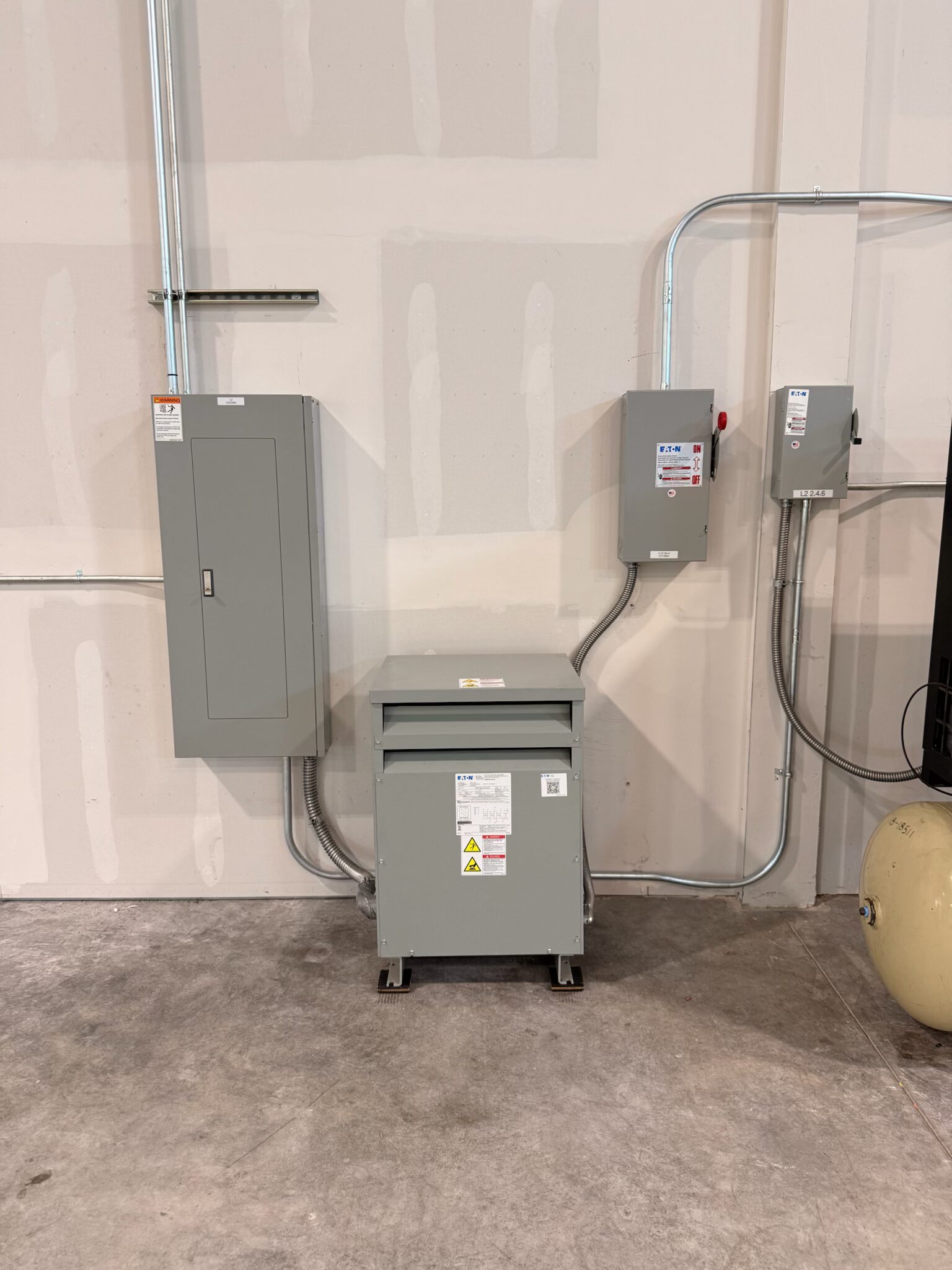
A transformer's job is to convert voltage from one level to another. In a commercial setting, this usually means stepping utility voltage down to what the equipment actually needs. The transformer on this project was a 45kVA Eaton unit — sized based on the total connected load of the production equipment it would be feeding.
Sizing a transformer correctly matters. Go too small and the transformer runs hot, shortens its life, and can fail under peak load. Go too large and you're spending more than necessary on equipment and potentially mismatching the protection scheme. The 45kVA rating was the result of adding up the nameplate loads of the machines, applying appropriate demand factors, and building in headroom for future equipment additions.
The transformer was floor-mounted adjacent to the new distribution panel, with conduit rising to the ceiling and connecting to the facility's main service. Inside, the windings are three-phase — visible when the cover is removed — with color-coded conductor terminations on the primary and secondary sides.
The Distribution Panel
Rather than running individual circuits all the way back to the main service panel from each machine, the better approach for a production floor is a local distribution panel fed from the transformer. That panel lives near the equipment and becomes the source for all the machine circuits in that zone.
The 125A Eaton distribution panel on this project is positioned directly above the transformer on the wall, with the Eaton safety disconnect mounted alongside it. From there, individual circuits branch out to each piece of production equipment — each with its own appropriately sized breaker, conduit run, and disconnect at the load.
This layout keeps circuit runs short (better for voltage drop), makes future additions straightforward (add a breaker, run a circuit, done), and centralizes the overcurrent protection in one accessible location.
Machine Circuits
Every piece of production equipment got a dedicated circuit. The conduit runs drop from the panel to each machine, with a safety disconnect installed at or near the equipment so anyone servicing it has a local lockout point. Duplex outlet boxes were run at machine height along the wall in EMT conduit for receptacle access between stations.
Liquid-tight flexible conduit was used at the final connection to each machine — it allows the equipment to be moved slightly for maintenance without stressing the conduit, and it handles vibration better than rigid conduit for equipment that runs continuously.
LED High-Bay Lighting
The lighting scope was straightforward in concept but matters a lot for a working facility. The existing fixtures weren't producing enough light at the floor level — a common issue in warehouses and fabrication spaces where the original lighting was undersized or has degraded over time.
LED high-bay selection for a space like this starts with the ceiling height and the target foot-candle level at the work surface. Fixture beam pattern matters too — a narrow beam gets more light onto a specific area but leaves gaps between fixtures, while a wider beam gives more even coverage. The goal is even illumination across the full floor without hot spots directly under fixtures or dark zones between them.
The finished result is a dramatically brighter workspace. Good lighting in a production environment isn't just a comfort issue — it directly affects how accurately people can do their work, how quickly they spot problems, and how the space reads during inspections.
What This Kind of Work Requires
Commercial electrical upgrades require a licensed contractor who understands load calculations, transformer sizing, demand factors, and equipment circuit design. This isn't work where estimating from experience is sufficient — the numbers have to be done correctly, the equipment has to be sized to those numbers, and the installation has to be inspected and meet code.
Cyber Electric handles commercial scopes including new facility buildouts, tenant improvements, manufacturing and fabrication environments, and agricultural electrical. If you're adding equipment, expanding a facility, or dealing with power distribution issues in a commercial space, that's a conversation worth having.
Category
Commercial Electrical
Published
June 2025
Written by
Cyber Electric LLC
License #1075088
Get an Estimate
Ready to move forward?
Licensed electrical contractor serving Modesto, Stockton, and the Central Valley. We review every request personally and follow up the same day or next morning.
License #1075088 · Modesto, CA