Hiring an Electrician to Install a Tesla Wall Connector or Level 2 EV Charger
Every Level 2 home EV charger — including the Tesla Wall Connector — requires a dedicated 240v circuit and a licensed electrician. Here's what that installation actually involves and what to ask before you hire.
If you just took delivery of a Tesla, a Rivian, a Ford F-150 Lightning, or any other electric vehicle, you've probably already figured out that the mobile connector that came with it is too slow for daily use. Plugging into a standard 120v outlet works in a pinch — but charging a 70 to 100 kWh battery that way means leaving the car plugged in for two days to recover range you used on a single commute.
A Level 2 charger solves that. It runs on 240v, charges 6 to 10 times faster than a 120v outlet, and lets you start every morning with a full battery regardless of how much you drove the night before. Getting one installed at home is the right move — but it requires an electrician, and not all electrician installs are equal.
Why Every Level 2 Charger Requires an Electrician
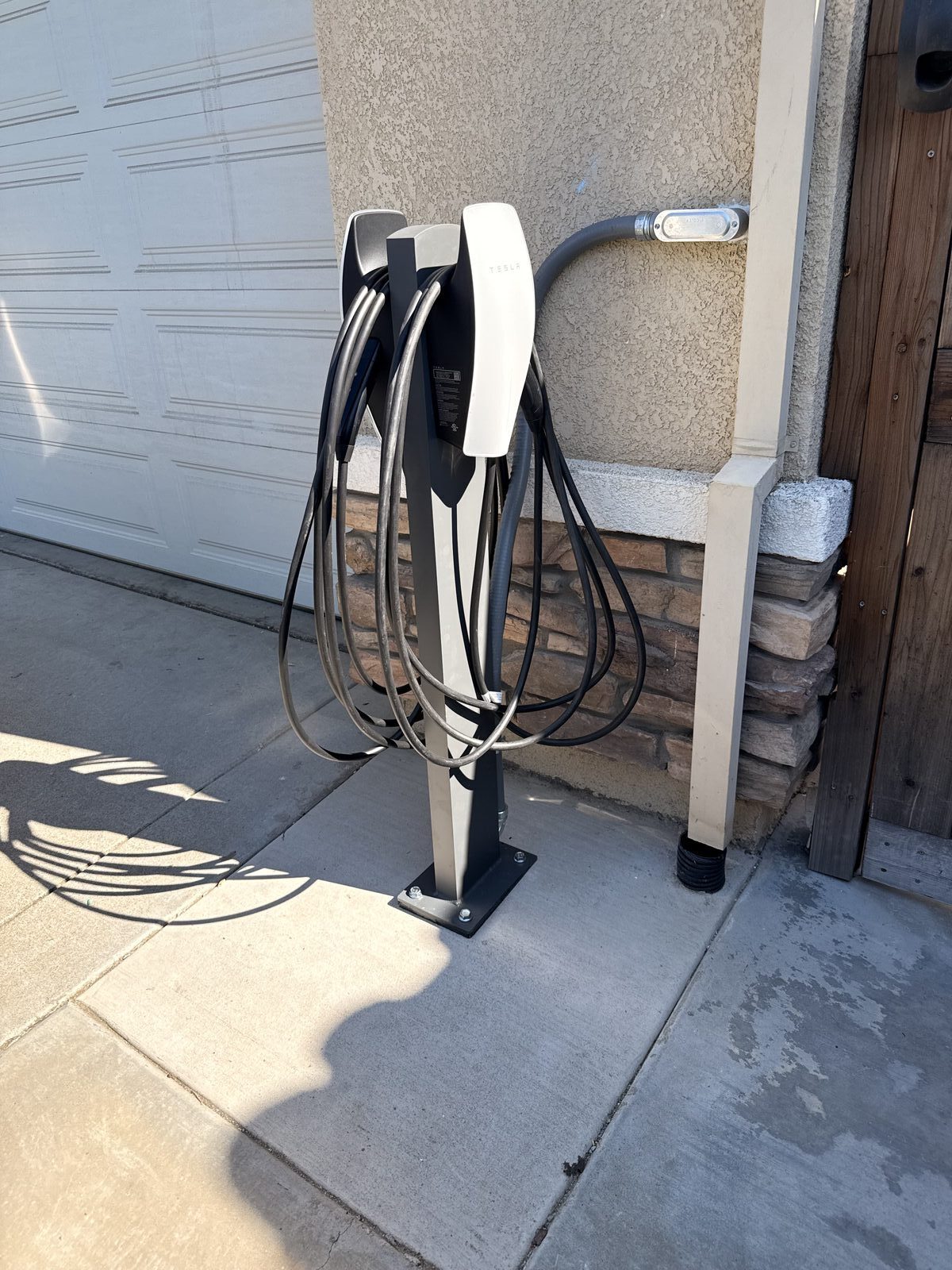
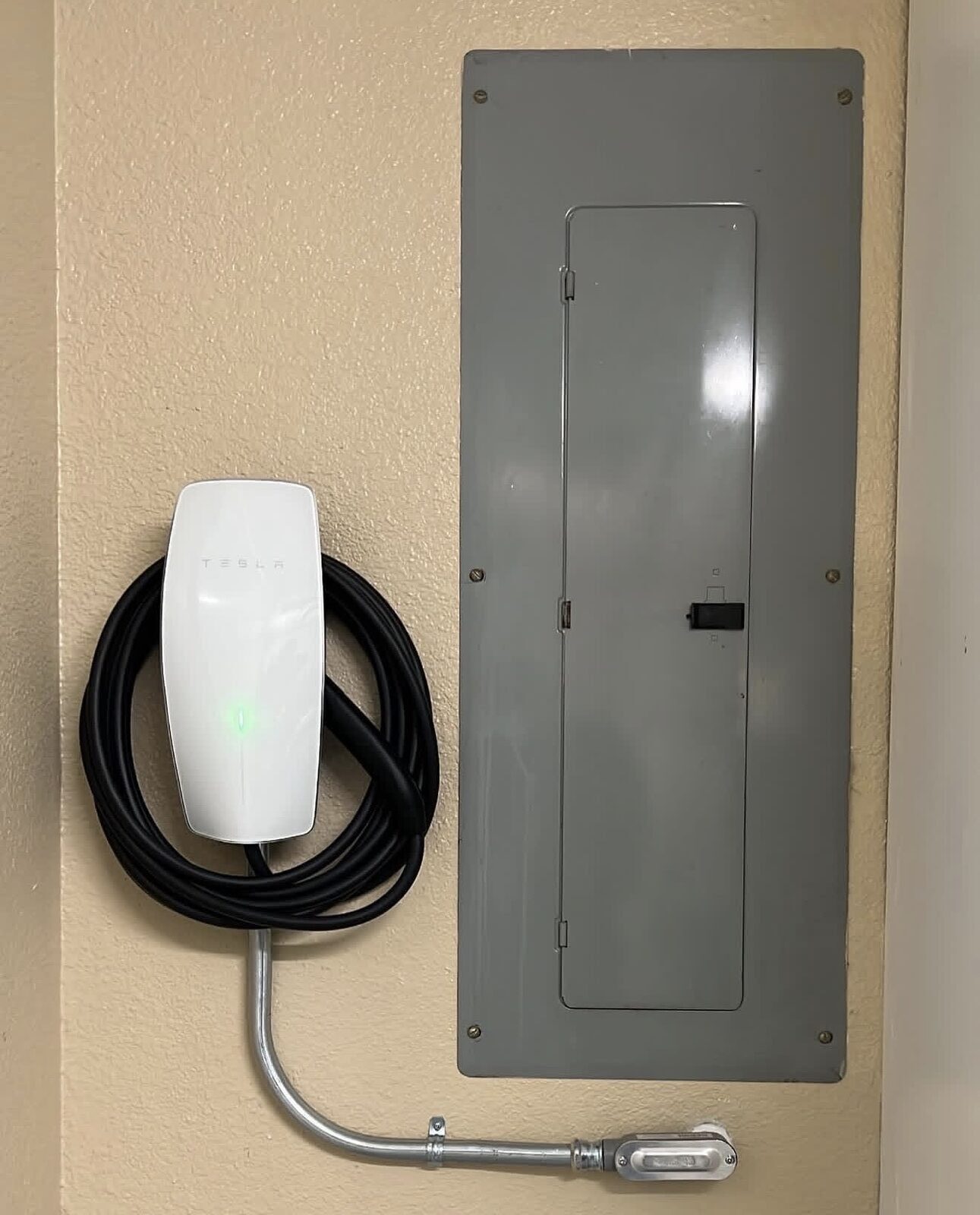
A Level 2 charger — including the Tesla Wall Connector — is not a plug-in appliance. It's a hardwired 240v device that requires a dedicated circuit: a new two-pole breaker in your electrical panel, appropriately sized wire from the panel to the charger location, and a permitted installation. In California, this is licensed electrical work.
The Tesla Wall Connector specifically is designed to be hardwired, not plugged in. It can be configured for any circuit size from 15A to 60A. Most residential installs use a 60A circuit (48A continuous), which gives you the maximum charge rate the Wall Connector supports. Undersizing the circuit limits your charge rate and defeats the purpose of installing a Wall Connector over a simpler NEMA 14-50 outlet.
What to Expect During the Installation
The core of the job is running a dedicated 240v circuit from your electrical panel to the charger location. For most garage installs, that means opening the panel, installing a two-pole 60A breaker, running wire through the garage wall or in surface conduit to the charger mounting location, and landing the wires at the Wall Connector.
What drives the time and cost is the distance and the path. A panel on the shared wall with the garage, three feet from where the charger goes, is a half-day job. A panel in a hallway, with the charger on the far end of a finished garage, requires running wire through walls or across the ceiling — that takes longer and costs more.
Detached garages add another layer: code requires a separate subpanel or outdoor feeder for a detached structure, which means additional work. The upside is that once you have power in a detached garage, you typically have enough capacity to add circuits later.
Tesla Wall Connector vs. NEMA 14-50 Outlet
The Tesla Wall Connector is not the only option. A NEMA 14-50 outlet — the same receptacle used for electric ranges and RV hookups — paired with the Tesla Mobile Connector gives you Level 2 charging at up to 32A (roughly 24 miles of range per hour). That's slower than a Wall Connector at 48A, but it's also compatible with other vehicles and can stay behind if you sell the car.
The Wall Connector wins if: you have a Tesla and plan to keep it long-term, you want maximum charge speed, or you prefer a clean wall-mounted unit over a cable management setup. The outlet wins if: you want flexibility, you might switch brands, or you're renting and want to take the charging setup with you.
Either way, the circuit work is nearly identical. Both need a 240v dedicated circuit. The Wall Connector uses a 60A breaker; the NEMA 14-50 outlet uses a 50A breaker. Labor is comparable.
What to Ask Before You Hire
Ask whether the electrician is licensed in California and whether the work will be permitted. EV charger installations are permitted work in most jurisdictions, and an unpermitted install can create issues with homeowner's insurance and future home sales. Ask whether they'll do the permit pull or leave that to you.
Ask whether a panel evaluation is included. If your panel is already full, you may need a tandem breaker, a panel upgrade, or a load calculation before the charger circuit can go in. A qualified electrician will flag this before starting — not after.
Cyber Electric installs Tesla Wall Connectors and Level 2 EV charger circuits in Modesto, Ceres, Turlock, Riverbank, Oakdale, and across the Central Valley. If you're not sure what your panel can handle or what the best setup looks like for your garage, we're happy to take a look.
Category
EV Charging
Published
June 2025
Written by
Cyber Electric LLC
License #1075088
Get an Estimate
Ready to move forward?
Licensed electrical contractor serving Modesto, Stockton, and the Central Valley. We review every request personally and follow up the same day or next morning.
License #1075088 · Modesto, CA