Tesla Wall Connector Installation: Garage Mounts, Pedestal Mounts, and What Two Real Jobs Looked Like
Tesla Wall Connectors are the right Level 2 charger for Tesla owners — but the installation varies more than most people expect. Here's what a standard garage mount and a freestanding dual pedestal looked like in the field.
Tesla Wall Connectors are the right Level 2 charger for most Tesla owners. The mobile connector that comes with the car works on a standard 120V outlet, but at 3–5 miles of range per hour it's barely keeping up with moderate daily driving. A Wall Connector on a dedicated 240V, 60-amp circuit delivers up to 44 miles of range per hour — most people plug in at night and have a full battery every morning.
The installation is straightforward in most cases, but there's more scope variation than homeowners typically expect. Here's what two real jobs looked like.
Standard Garage Installation
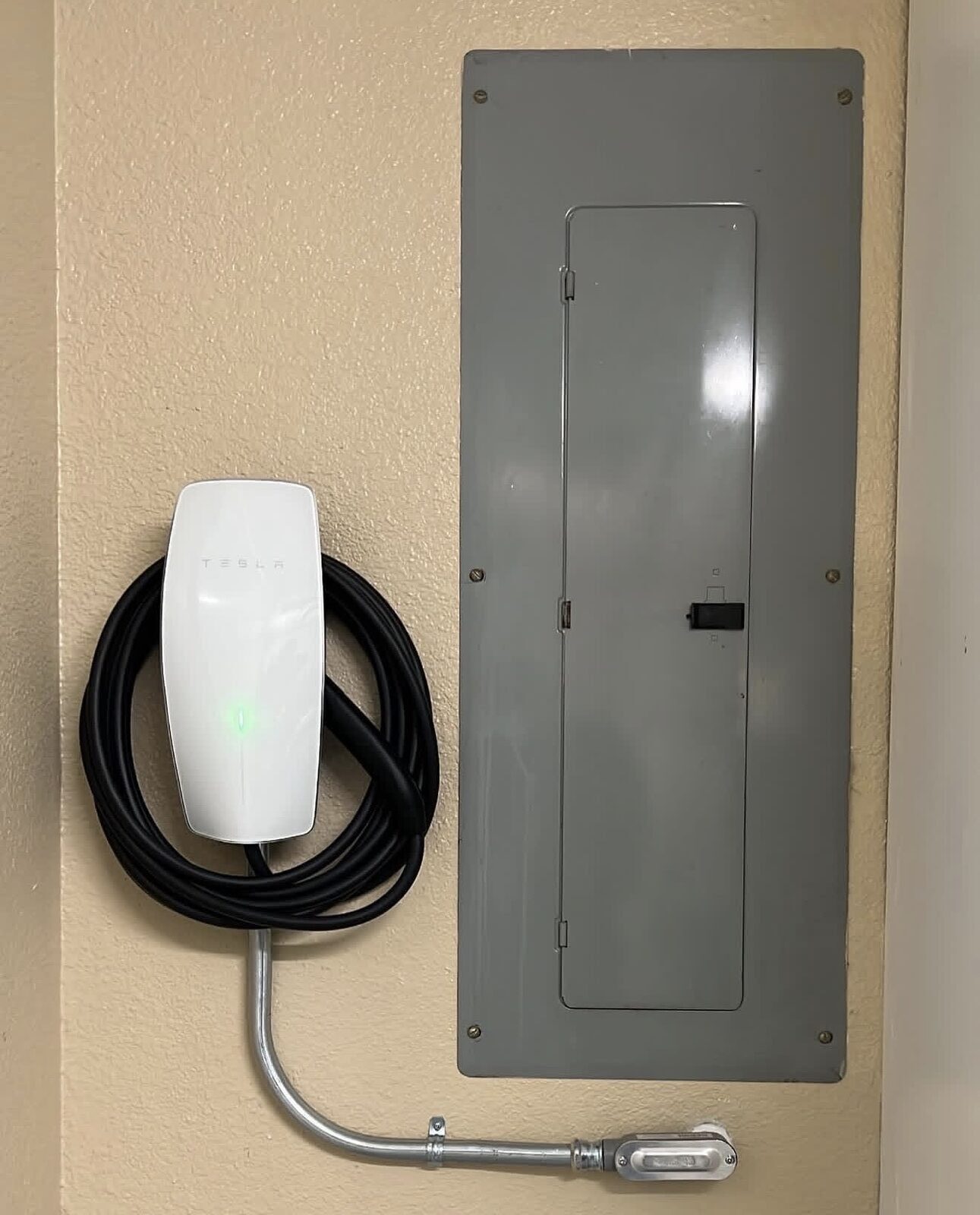
The most common Wall Connector job is a garage wall mount — a dedicated 240V circuit pulled from the panel to the charger location, EMT conduit where the wire is exposed on the wall, and the unit mounted at a height where the cable easily reaches the vehicle's charge port.
One of our recent installations used a short EMT run from the breaker to the unit, mounted directly adjacent to the panel on the garage wall. The green ready light was on before we left the site. A second garage installation had a longer run — the conduit travels vertically from the circuit entry point to the mounted unit above. Both are half-day jobs when the panel is in the garage.
Inside each Wall Connector, conductors land on the L1, L2/N, and ground terminals and get torqued to the 50 lb-in spec on the label. Tesla requires copper conductors only — no aluminum in the Wall Connector terminations. Wire gauge is sized for the breaker amperage.
Dual Pedestal Mount — Two Chargers, One Post
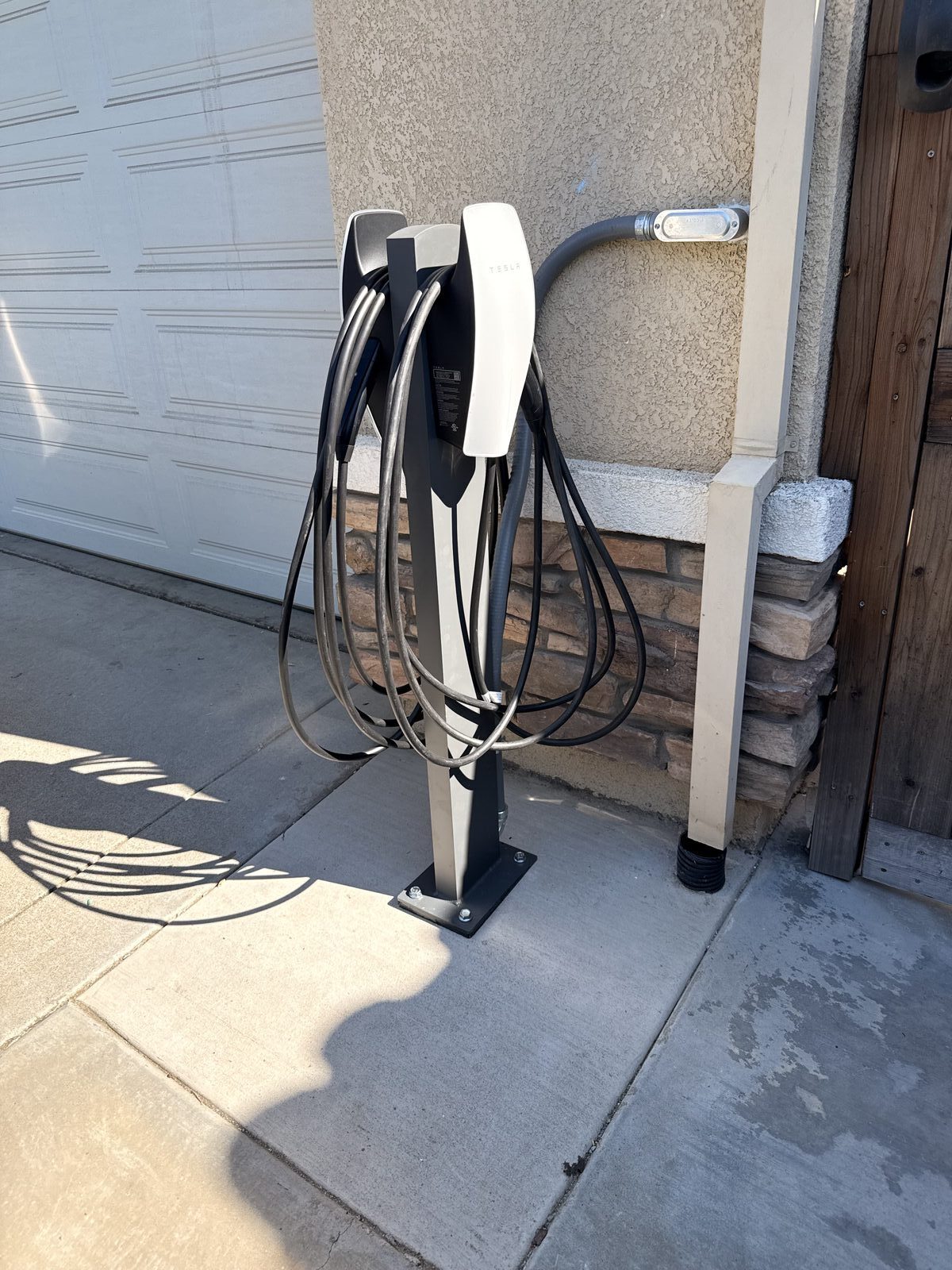
One Modesto installation used a freestanding pedestal post instead of a wall mount — the client had two Teslas and wanted charger access from either side of the driveway without running two separate conduit runs to two wall locations.
The solution was two Wall Connectors mounted back-to-back on a single post, anchored to a concrete base plate. One conduit run comes up through the base of the pedestal and feeds both units. The post keeps everything clean — no wall penetrations, no exposed conduit running along stucco.
Both units were wired identically and verified before closeout. On a 60-amp circuit, each connector delivers up to 48 amps of continuous charging, enough to fully charge most Tesla models overnight from near empty.
Permits and Configuration
EV charger installations in California require a permit in most jurisdictions. We handle the permit as part of the job. After installation, the Wall Connector is configured through the Tesla app — it connects to your home WiFi and integrates with the vehicle for scheduled charging and monitoring.
If you have two Teslas or are planning ahead for a second vehicle, two Wall Connectors can be set up in a power-sharing configuration that automatically balances load between the two chargers on a single circuit. If you're buying a Tesla and haven't scheduled the charger installation yet, the right time to do it is before the car arrives.
Category
EV Charging
Published
May 2025
Written by
Cyber Electric LLC
License #1075088
Get an Estimate
Ready to move forward?
Licensed electrical contractor serving Modesto, Stockton, and the Central Valley. We review every request personally and follow up the same day or next morning.
License #1075088 · Modesto, CA